Wednesday, January 15, 2014

415 Feet installed!

The agronomy staff has been working hard to take advantage of the opportunity to accomplish a few key projects around the course to improve playing conditions for the upcoming season.  The biggest opportunity that we get each year to do this is when the growth of our turf ceases or significantly slows down during the months of  December, January and February.  This frees our labor force up from the routine maintenance that takes up so much of our time during the season.

Each year, we assess the status of slow draining areas on the golf course and attack the wettest areas that have the largest impact on how the golf course plays.  The areas in the rough on the left and right side of #3 green have been chronic wet areas for the past few seasons so we decided to start here first.

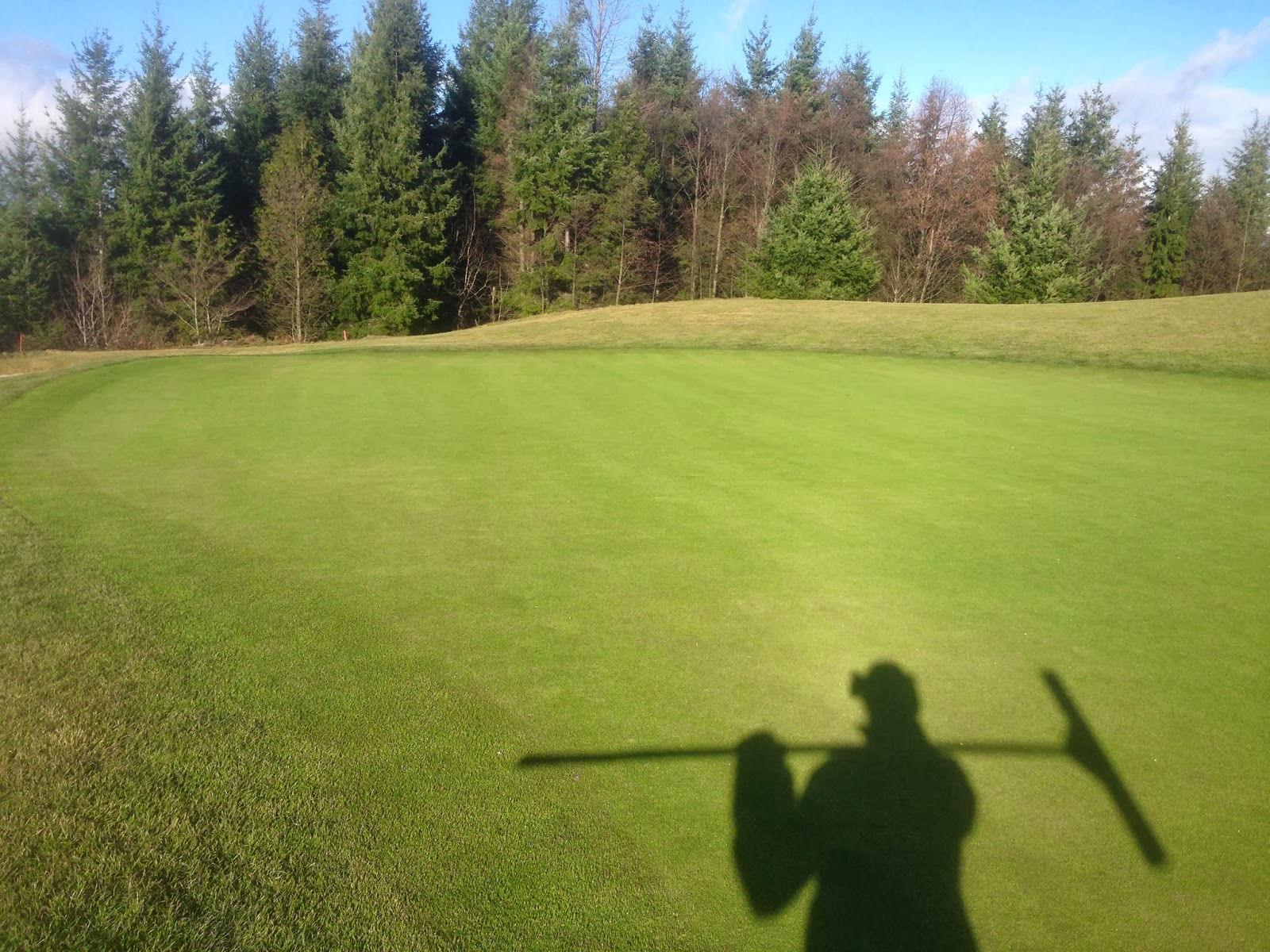
The left side of the green was completed at the end of last week with a total of 270 linear feet of 4" perforated pipe installed.  Today, we are in the process of capping our trenches on the right side of the green with sand and sod today and the linear measurement for this area is 145 feet, bringing our total amount of installed pipe to 415 feet.  Both areas are already a little bit drier than they were before, however, since the area was already wet, we will likely not see the full benefits of the drainage until early this summer.  We are excited to have this process started and our next project will be on the 15th fairway in the landing zone, about 120 yards back from the green.

The mainline for our herringbone design on the left side of the green.

Fingers running off the mainline.

A little visual of the entire area.
Left side all done.  Pipe, gravel, sand and sod installed!

Getting ready to start the right side.  Sod removed and ready to dig!


A lot of ground water in this area, the first scoop we took, the hole filled up with water.

Notice all the water already moving through the trench.  

Digging the final finger of this area.

Tuesday, December 24, 2013

Sun and Shade

Seven hours, 34 minutes and 4 seconds.  THAT is how much less daylight (sun) that we experience here in the city of Snoqualmie on December 21st compared to June 21st.  These dates are the days on which we experience the shortest day of the year and the longest day of the year, also known as the winter and summer solstices.    

As we all know, one of the essential ingredients to growing turfgrass is sunlight.  Without sunlight, the turf has no energy and is handicapped in it's ability to utilize it's food sources to produce and maintain it's roots and shoots.  Add the stresses of nasty winter weather (remember the bitter cold temperatures of a few weeks ago?) and traffic on top of that and it is a given that you won't have a happy turfgrass plant.  

Our golf course is spread out over a large area, with each hole in it's own micro climate which is largely created by the topography of the land around it as this can determine air flow, temperature and sunlight exposure which can drastically affect turf performance from hole-to-hole.  

Take a look at the photo below.  This is hole number six and this picture was taken around 11:00 AM yesterday.  If yesterday's sunrise occurred at 7:56 AM, this means that this green got about 3 hours of sun before disappearing behind the houses and trees to the right of the cart path, leaving the green in the shade for a little over 60% of total daylight hours.  That definitely takes a toll on the turf.  

Hole #6
 Now, take a look at hole number 5 which sits in the sun for the majority of the day, due to the topography that it sits on.  This picture was taken at the same time of the day as the one above.  The entire green is basking in the sun and looking pretty happy.
Hole #5
Limited sunlight is one of the many challenges that we face when it comes to keeping the greens healthy through the winter months and with that said, we have decided to place holes #6 and #11 on temporary greens which are located just short of each green.  These greens are located in some of the most challenging micro climates on the golf course with minimal sunlight during this time of the year and in order to minimize stress to the turf, we need to give these greens some time off.  Many of you have expressed your appreciation of our proactive efforts and we appreciate your support.  As always, if you have any questions or concerns, please feel free to contact me at rgordon@tpcsr.com.

Tuesday, December 10, 2013

Dang, that was cold!

Have you ever had somebody sneak up on you and dump a bucket water over your head that is so cold that you lose your breath?  I have a feeling that is kind of how our Poa greens are feeling after this recent extended cold snap.  We set records around the Puget Sound region for low temperatures that dipped into the single digits and teens for some areas over a period of the last eight days.  Five of those days didn't even see the high temperature climb anywhere past 29 degrees.  It was COLD!

When you grow Poa, anytime you experience weather extremes whether it be extremely high or low temperatures, you get a little concerned as the possibility of turf loss becomes very real.  Extremes such as this cause Poa to lose basic physiological functions needed for survival.   Last time we experienced a deep freeze like this one was 2009 and that was a rough year for golf courses throughout the Puget Sound region, as many Poa greens were unable to handle the weather extremes and simply checked out.  

Initially, I had hoped that the deep freeze would have a little bit of moisture mixed in with it as that would have produced a little bit of snow which is one of Mother Nature's best lifelines for grass (to a certain degree of course) and would have given our turf a little warm blanket to hide under, away from the frigid temperatures.  Unfortunately, the ridge of high pressure pushed all the moisture down to Oregon where they got the snow I was hoping we would get.

The good news is that we had a little bit of lead-time in which we were able to do a few things to prepare the greens for the deep freeze in order to give the greens the best odds we possibly could.  As some of you noticed, we put a slightly heavier than normal sand topdressing application on all of our greens on the 29th.  The sand simply serves as insulation for the crowns (growing point between shoots and roots) for the plant.  While it is not as good as snow, it was better than nothing.  The other thing we have working in our favor is we mixed a little green pigment in our last spray application.  While the use of pigment has many benefits, one of them is the increase in surface temperature due to the reflection of light off a darker surface producing added insulation and quicker recovery from cold temperatures.  Otherwise, there is not much else you can do except wait for the weather to change and growing conditions to improve.

I have been surveying the golf course all week and as of today, I am feeling cautiously optimistic.  There are a few areas on the perimeters of our shady greens that look a little dinged up due to winter desiccation and may struggle through the rest of the winter a little bit.  However, with conservative traffic management, I do not anticipate any major turf loss.  The turf  on all areas will be coming out of this cold snap a little off-color, especially our roughs and bunker faces where we have a lot of fine fescue and bluegrass.  This is simply the defense mechanism of the grass dormant until growing conditions improve.

Right now, we are waiting for the green surfaces to soften up a little bit so the plants can begin re hydrating themselves and getting a little bit of rigidity back into the leaf blades as water moves back into the plant cell walls.  As of this afternoon, any traffic across the greens right now is leaving very visible footprints in which the leaf blades are slow to bounce back.  This means the Poa is not quite ready for golf.  Check out the picture below: this shows actual footprint patterns of ONE foursome playing the hole like normal.  That's why we've got to be careful not to expose the greens to traffic too soon.   The forecast is calling for temperatures to warm up into the 40's with a little bit of rain which is perfect for what we need to help the greens recover from the shock of the cold snap.


To summarize, we need to make sure we give the greens the opportunity to re-acclimate themselves so they are strong enough to handle the foot traffic from regular play without causing any unnecessary injury.  We will continue to monitor conditions and will be in constant communication with the pro-shop with further details as we want to get the golf course open again as soon as possible which should happen within the next few days.  In the meantime, thank you for taking the time to read through this LONG blog post, for your understanding and patience as we work to get the course open again and please don't hesitate to contact me if you have any questions.


Monday, November 18, 2013

Comparing Rainfall Totals

Those of you that braved the rains out on the course this past weekend and love trivia, here's a tidbit of information for you to chew on: our on-site weather station recorded 2.48" of rain between Friday and Saturday, with most of it coming down on Saturday.


Out of curiosity, I decided to pull up some old weather data records from 2011 and 2012 to see how the fall rains stack up to what we have experienced thus far in 2013.  Many of us consider September to the kick-off of the fall season so, I took a look at the time period between September 1st through November 31st for all three years.  Here's how the data stacked up:

  • September-November 2011:  19.08" Rainfall
  • September-November 2012:  11.21" Rainfall
  • September-Present 2013:  18.69" Rainfall (Through November 17th)

We still have thirteen days of data to add to the November 2013 rainfall records, however, to-date we are only 0.40" from beating the 2011 rainfall record and have already incurred 7.48" more rain than we did in 2012 during this time period.  Needless to say, I think we are on-track to end up beating the rainfall totals for the previous two years by a lot.  

Tuesday, October 29, 2013

When the Frost is on the Punkin

Photo Credit: Juan Wilson on 28 October 2010 for Island Breath - 
(http://islandbreath.blogspot.com/2010/10/frost-on-pumpkin.html)


It finally happened.....Frost on the Punkin!  I had to scrape a good layer of ice off my windshield this morning and our fairways, roughs and tees were covered with billions of gleaming white ice crystals when I pulled into the shop parking lot at 5:30 AM.  While this frost was not quite a full-blown hard frost (the low was 33 degrees) it did put a kink in the maintenance crew's plans for the day as we had to wait a few hours before starting some of our planned tasks and ate into our head start on play a bit.  Luckily it did not affect our regular 9:00 AM tee times this time around.

Following Mother Nature's cue, I figured now would be a good time to review a little bit on frost protocols here at the club as it pertains to golf course prep and tee times.  Now to state the obvious, frost delays are something that none of us like to experience because as I mentioned above, it steals precious time away from the maintenance crew's head-start on play and does the same to the valuable playing time of our members.  
It messes up plans for everyone involved, simple as that.  

However, at the end of the day we are all in this together as we have the common goal of making sure that the golf course is looked after in order to provide the best playing conditions not just right now but next week, next month and next year as well.  In order to do that, sometimes we have to make decisions that look past the short-term.  Managing frost delays appropriately is one of them.


Here is what we ask of our members and guests during frost:
  • Before coming to the club to play, track the weather.  A basic rule of thumb is when predicted temperatures are to be around the 40 degree mark or colder, chances of frost are high.
  • Upon arrival at the club, please check in with the pro shop for the thumbs-up to use the range tee and putting green before starting your day.  Normally, the putting green and range are among the first to clear and delays for these areas are usually minimal.  We do have our covered hitting bay on the South end of the range for your use during those prolonged delays.  
  • Get confirmation from the pro shop that it is OK to tee off on the first tee before proceeding.  Sometimes, things may not be what they seem.  Our first two holes have tall Douglas Firs around them that block out the morning sun and significantly prolong the burn-off of frost relative to the greens that you can see around the clubhouse (putting greens, #18 and #10).  
  • Keep your cart on the cart path.  Often times, we will allow play to begin before the frost has fully cleared off shady areas of our fairways and roughs (but has cleared off our greens).  This is a calculated risk that we take as well as a concession that we make in the name of providing excellent customer service.  Please take this request seriously and be considerate of your golf course.  
Fir trees blocking morning sun on #1 green.

We do our best to provide estimates of if and when frost will clear, however, this is often very difficult if not impossible to do.  Truth be told, if I had the ability to predict this with 100% accuracy, I would be a self-made millionaire and probably on a beach somewhere in Hawaii.  (Insert big grin here).  Each frost delay is evaluated on a case-by-case basis and we will do our best to communicate the progression of the thaw-out through the pro shop.  

One thing that many of us often forget is that even after the frost clears, the maintenance staff still needs to get out on the turf to prepare the course for play in front of golfers and this takes time.  We do not mean to prolong the delay as our goal is to provide you and those after you with the best possible playing conditions that day whether that means mowing the greens, cutting a fresh cup or raking the bunkers.  Now enough business talk, here is a nice little poem by James Whitcomb Riley (1853-1916) to get you in the mood for frost season:

"When the Frost is on the Punkin"
WHEN the frost is on the punkin and the fodder's in the shock,
And you hear the kyouck and gobble of the struttin' turkey-cock,
And the clackin' of the guineys, and the cluckin' of the hens,
And the rooster's hallylooyer as he tiptoes on the fence;
O, it's then the time a feller is a-feelin' at his best,         
With the risin' sun to greet him from a night of peaceful rest,
As he leaves the house, bareheaded, and goes out to feed the stock,
When the frost is on the punkin and the fodder's in the shock.
  
They's something kindo' harty-like about the atmusfere
When the heat of summer's over and the coolin' fall is here—  
Of course we miss the flowers, and the blossoms on the trees,
And the mumble of the hummin'-birds and buzzin' of the bees;
But the air's so appetizin'; and the landscape through the haze
Of a crisp and sunny morning of the airly autumn days
Is a pictur' that no painter has the colorin' to mock—  
When the frost is on the punkin and the fodder's in the shock.
  
The husky, rusty russel of the tossels of the corn,
And the raspin' of the tangled leaves as golden as the morn;
The stubble in the furries—kindo' lonesome-like, but still
A-preachin' sermuns to us of the barns they growed to fill;  
The strawstack in the medder, and the reaper in the shed;
The hosses in theyr stalls below—the clover overhead!—
O, it sets my hart a-clickin' like the tickin' of a clock,
When the frost is on the punkin and the fodder's in the shock.
  
Then your apples all is gethered, and the ones a feller keeps  
Is poured around the cellar-floor in red and yaller heaps;
And your cider-makin's over, and your wimmern-folks is through
With theyr mince and apple-butter, and theyr souse and sausage too!...
I don't know how to tell it—but ef such a thing could be
As the angels wantin' boardin', and they'd call around on me—  
I'd want to 'commodate 'em—all the whole-indurin' flock—
When the frost is on the punkin and the fodder's in the shock.

Tuesday, October 15, 2013

Fall 2013 Greens Aerification in the Books!

It has been exactly twenty-one days since we core aerified and sanded our greens.  I wanted to share the following sequence of photos, showing the healing process.  Each photo was taken at 10 day intervals, beginning on the day that we aerified the greens.  Notice the progression of the holes getting smaller and the sand working itself into the turf canopy as time passes.

September 24th- day of aerification

October 4th- 10 days later.

October 14th- 20 days later.
One of the most important things that we do during the aerification process is add sand to the putting surface.  This accomplishes a few fundamental things:

  • Dillutes thatch buildup.  If left unchecked, thatch can cause the green to become spongy and prone to disease and weeds.
  • Firms up putting surface.  This enhances ball roll and reduces pitting from balls landing on the green.
  • Smooths out the putting surface.  The addition of sand smooths out the low spots for a truer ball roll.
Last winter on a hunch, we took a hard look at our sand source and found through professional lab testing, that the quality control on our existing sand source had declined below our standards and had ratios of silt and clay that were much too high.  Silt and clay are not ideal additions to a greens profile as these are tiny particles that can clog up pore space, reducing water infiltration rates and gas exchange capabilities (oxygen).  After a lot of testing and research, we were fortunate enough to find another pit in the area that produced a exemplary sand that was compatible with the existing sand in our greens profile.  

This fall was the first time we had used the new sand source in the aerification process and we immediately noticed a significant difference with how easy the sand fell into the holes and worked itself into the profile.  There was not as much "bridging" of sand across the holes which meant we were able to add more sand than ever before to the greens profile.  The sand was not as sticky (less silt and clay), so it was much easier to work it into the canopy which promoted faster healing time and less wear and tear on our mower blades.  

To summarize, the new sand made everyone happy.  The agronomy crew did not have to work as hard to get the sand into the profile, our mechanic did not have to work as hard to keep the mower reels sharp and our membership got to putt on grass rather than sand sooner than past aerifications!    

Friday, August 2, 2013

New Practice Green Open!

Those of you that have been following our progress on the south end of our practice facility, you have probably already noticed that the second green officially opened up for play last weekend.  The green is still only 16 weeks old and has been completely grown in using aerification plugs from our existing greens.  

South end practice facility.  New green in the background and existing chipping green in the foreground.

This green will eventually become our South-end practice putting green in the coming months but for now, it is our chipping green as the trueness of the surface needs a little bit more time to mature.  In the meantime, it has become dense enough and strong enough to handle regular foot traffic and pitch marks from balls.  We wanted to offer our membership a variety of options to practice their short game this season thus, we have accelerated the process and temporarily made our chipping green in this area (which was grown-in the exact same way in 2010) the putting green as the quality of the surface on this green is much truer and more conductive to ball-roll right now.

The turf is still filling in and has come a long way in the last 16 weeks.

We are slowly dropping the height of the new green to match up with the rest of the greens, right now they are 75 thousands of an inch apart in height.  We will continue to implement cultivation practices such as topdressing, verticutting and frequent mowing which will promote the quality putting surface that we desire. 

Fresh mow on the green, right before the inaugural cups were cut.  The area around this green will be removed and replanted in September/October.

 This fall we will continue the renovation of the south end practice area by removing much of the remaining bentgrass that was left over from the old green and growing in a new approach area between the two greens using fairway aerification plugs that will be used to pitch balls over the bunker onto the chipping green.  The smaller areas on the left and right hand side of the new green will be converted to rough height as to frame the green a little better.  This project will wrap up by switching the two greens back to their original chipping/putting designations at the start of the 2014 golfing season.   

Inaugural cups are cut and the green is ready for some chipping action!