Sunday, April 3, 2016

One Year Later

I have not blogged since last Spring and quite honestly, a lot has happened since then.  So, those of you that have been waiting patently for my next post, lo and behold, here it is!  I started the 2015 season with a brand new assistant as the former deservingly moved on to take his first superintendent's job.  After that we were plunged into our first summer with water restrictions due to abnormally dry and hot conditions (in Seattle!?) and then subsequently went through one of the wettest offseasons on record.  I have spent 10 seasons here at TPCSR and never experienced either one at these extremes.  Go figure they happen in the same year.  It's always a interesting ride being at the mercy of continually moving forces whether it be driven by nature or man.

Despite the challenges of 2015, I mark it as a very successful year as we were able to maintain the positive momentum of the last few years in terms of course conditioning and infrastructure upgrades.  A list of infrastructure accomplishments over the past year include:

  • Drainage.  Installation of 9,000 linear feet of drainage on holes #15, #16 and #17 plus a few small in-house projects.  It sure was fun being able to drive a cart down #15 fairway after a heavy rain this winter when a year ago, that thought would have never crossed my mind.
  • OB Posts.  Replacement and installation of 350+ custom made OB posts throughout the property.  The old ones were beginning to rot, faded and just plain ugly.  The new ones are a little more tasteful in design and look much better.
  • Stairs.  Those of you that routinely walk the course are sure to have noticed that all of the stairways and bridges on the golf course received a face lift this past winter.  Rotted stair risers were replaced, new stone was laid, new non-slip matting was laid on the bridge on #4 and stairs down to #6 red tee and we installed a new handrail as well. 
  • Irrigation.  The staff spent countless hours this past winter making improvements to our irrigation programs in our central control, upgrading maps, replacing worn out nozzles and raising sunken heads for better coverage.  The irrigation system is the lifeblood of our golf course and the work completed will make the operation and management of the system more efficient, thereby producing better turf conditions. 

Right now, our focus is on putting the final touches of getting ready for the 2016 season.  The aforementioned list in addition to our upcoming plans will greatly contribute to this year's formula.  We have aerified the greens as of this past week which unofficially (from a turf manager's standpoint) marks the true beginning of the season.  I expect they will heal up quickly if the warm weather we have been having lately continues.  

On top of that, I am also excited to announce that Golf Plus Construction will be returning to the property on April 11th to install 5,000 linear feet of drainage.  If the weather cooperates, we will average about 1,000 linear feet a week putting the timeline at approximately six weeks to complete.  Primary focus will be put on holes #2 and #3 this Spring with a little bit of clean-up work in other areas on the golf course.  At the end of this project, we will have installed 21,000 linear feet of drainage in the past three years.  That's almost 4 miles!

When work is happening on the golf course, we will be following the same practice as the past few years of placing the tee markers on the fairway ahead of where work is happening.  This is the only way to keep the staff working safely and productively.  Tee markers will always be returned to the tee boxes for weekend play and most Friday afternoons.  Updates on drainage work will be given to the pro shop daily so be sure to check in before your round so you know what to expect on the golf course.

Furthermore, we have ordered all brand new accessories for the golf course.  All items are scheduled to arrive within the next four to six weeks and once we have them, you will begin to see new items appear on the golf course such as tee markers, trash cans, divot bottle racks hole identification and directional signage.  Then of course, the new cups, flag sticks and flags on greens.  These items will give our golf course a much needed face lift and quite honestly, a more polished look.  

A lot happens in a year, right?  I plan to return to my active blogger status so check back for more updates as we move forward with this season.  I hope you are just as excited as I am to see some of the new upcoming improvements and changes.  Welcome back to the blog!


Thursday, March 26, 2015

2015 Drainage Project Kickoff

We are pleased to announce that the club has contracted with Golf Plus Construction to install 8,000 linear feet of drainage on the golf course this spring.  This project is another piece to the puzzle of the club's push to provide improved shoulder-season playing conditions.  

Golf Plus Construction is owned by Daniel Soushek.
Last year's installation of 4,000 feet of drainage on the 18th hole, also installed by Golf Plus Construction proved to be wildly successful based off the observed conditions this past winter as this hole went from one of the wettest to one of the driest in a single season.  The agronomy team is very excited to continue this initiative once again this spring and hope that you share our excitement as we get started.  

Our plan is to work Monday-Friday through the month of April and early May, averaging 1,000 feet a week with a three-man team working on the project barring any wild weather events.  We are beginning on the 15th hole and will clean up the remaining wet spots on the top of the fairway in the first landing zone as well as a few cart access areas between the path and fairway.  After that, we will be moving to the 16th hole and knocking out every single wet spot in the fairway and cart access areas.  The next stop will be the 17th hole where we will address a few chronically wet areas, namely to the right of the green, just above the approach area.  At that point, we will evaluate how many feet of the 8,000 feet we have remaining and allocate appropriately to other holes.

Getting started on #15 on March 25th.
It goes without saying that our ultimate goal throughout this project is to minimize the impact on our members' experience when playing the course.  With that said, we have also formulated a strategy to keep our installation team working as safely and efficiently as possible.  Our experience has shown us that the approach that we used last year as well as in 2012 worked quite well.  We will be moving the tees up onto the fairway to eliminate any tee shots over the heads of our crew, depending on where they are working at that given time.  The tee markers will be placed in a spot as flat as possible while also maximizing the yardage on that particular hole.  This course setup will be in effect Tuesday-Friday with the tees returning to the normal tees every weekend.

We will be diligently communicating project updates and locations to the golf shop on a daily basis so I highly encourage you to check in with them before your round if you are interested to know our plans for that particular day.  I would also like to thank you all in advance for your enthusiasm and patience as we work to get this project completed.  A little short term pain for long term gain in the end will be worth it as we'll be enjoying much drier fairways this next winter.  If you have any questions or feedback in regards to this project, please contact me anytime at rgordon@tpcsr.com.   


=


Monday, February 9, 2015

Sod Bunker Liners

We have a lot of bunkers here at TPC Snoqualmie Ridge.  One-hundred-fourteen bunkers.  All of these bunkers were constructed right on top of the property's native soil which is known as glacial till; a very dense mixture of boulders, gravel and coarse sand.

This stuff is what is merely inches underneath the white silica sand that is in our bunkers.  Throw high annual rainfall amounts on top of the sand (75 inches in 2014) and BAM, you have frequent bunker washouts in which the sand is pulled off the sides of the bunkers, exposing the rocks and gravel underneath the sand.  This is a perfect recipe for creating bunkers littered with unwanted debris such as silt, gravel and rocks.

Glacial till exposed in a bunker following heavy rainfall.
This is obviously a headache for the maintenance staff to maintain and frustrating for golfers to play out of.  The solution to this problem actually has many options.  There are a myriad of different types of  liners on the market that can be laid down on top of the subsoil on the floor of a bunker prior to filling with sand in order to keep the two elements separate and minimize contamination of the bunker sand.  It seems like each region of the country has a preference for the type of liner used in their bunkers.  The Puget-Sound region is no different.   

A very popular option in our area of the country has been to line the bunker floors with sod.  Several local courses have recently completed or are in the process of completing bunker renovations in which this method is employed.  I recently had the privilege of attending a chapter meeting for our local superintendent's association at Fircrest Golf Club in which I was able to see this process firsthand.  The club is currently renovating it's bunkers and as the picture below shows, they are using the sod liner method.  
Bunker at Fircrest Golf Club lined with sod.
As you can see, the process is relatively simple.  The floor of a bunker is lined with sod with the exception of the drain lines to maximize the flow of water through the bunker sand.  The sod is laid down and given time to take root which at this time of the year can vary between six to eight weeks.  Once the sod is firmly rooted, the grass is scalped down to stress the turf and/or sprayed with round-up, followed by smothering with new bunker sand.  The thatch layer from the sod is essentially what serves as the liner that keeps unwanted rocks, gravel and silt from contaminating the clean bunker sand. 

Through my years working in the industry, I have learned that what works somewhere else many not necessarily work here. We deal with many extremes here, especially as it pertains to weather.  I am not so sure that this method has the ability to hold up to our high rainfall amounts and the constant exposure that the sod would receive due to bunker wash-outs.  So, the only thing to do is do a test-run and try it and learn from it!  For this experiment, we have chosen the greenside bunker on the right hand side of the 12th green.  This bunker is actually one of the most contaminated bunkers we have and no matter what we do, we can't seem to keep the sand clean of rocks and gravel.  

We plan to begin work on this bunker this week starting with excavation of the old sand.  Once the sand is removed, we will touch up our drain lines with new gravel as needed, order some ryegrass sod and get it rolled-out on the bottom of this bunker.  After that, we must wait the prescribed six to eight weeks for the sod to take root before we can come back and cover it up with sand.  This way, the liner will be anchored properly where we need it.  

In the meantime, if you happen to hit your ball into this bunker, please play it from the drop zone that we will have painted next to the bunker or if you are playing for fun, you may play it as it lies in the bunker.  All we ask is that you take extreme care when walking on the newly laid sod as not to disrupt any newly formed roots which will be very important for the anchoring process. 

We are excited to see how this project turns out and will be monitoring the results over the upcoming season.  Perhaps, this could be our solution to those burdensome rocks that plague many of our bunkers.  We shall see . . .

Friday, January 9, 2015

New Year, New Projects!

Happy New Year from the TPCSR agronomy staff!  With the holiday season behind us, we are excited to get a few new projects underway in the next few of weeks.

Foggy morning at TPC, highlighting the sun's rays. 
First up, is a few in-house drainage projects.  You may have noticed already that we installed some drainage along the cantilever of #10 cart path where water seepage was a constant issue year-round.  Our charter members may recall that this has been an issue tracing back to the days when the course was newly constructed.  It will be nice to not have to drive by and look at a mud pit any more.  We put in 200 feet of pipe to capture any water coming off the hillside towards the cart path and tied it into a drain at the bottom of the hill.  As with any drainage project, we expect to see the full benefits beginning next season after the area has a chance to dry out this summer and begin next winter with a clean or I should say, dry slate.    

New drainage along #10 cart path.
Next up, beginning Monday the 12th we plan to begin installation of 500 feet of drain pipe on the right side of #11 fairway starting about 165 yards back from the green and going all the way up to around the 85 yard mark.  These two projects will kick off our season of doing as many in-house projects as we can before summer time mowing frequencies and other maintenance start to take over our time.  If you happen to be playing next week, please be mindful of where you land your balls on this fairway as this can be somewhat of a blind shot where you run the risk of hitting into our team working on the project.  

The new OB stake style is pictured on the left and the old on the right.  
Another project that we are excited about is the replacement of our out-of-bounds stakes.  The existing ones made of wood are over ten years old, rotting internally, falling over crooked and covered with faded paint.  We have chosen to upgrade the design with a little more sophisticated detail that will reflect the style and quality of the course a little better.  Our staff has been hard at work with the chop saw, router and a few gallons of white paint.  Once the stakes are complete, we will begin installation on the golf course, slowly completing the project between our other projects and routine maintenance tasks with the goal of complete installation by May 1st.

Friday, December 5, 2014

Snow and Ice, what shall we do?

We made it through the heavy rains of October, two cold snaps in November, and our first snowfall of the off-season.   The latest weather event kept us off the course for a few days as the snow and ice stuck around due to consistently low overnight temperatures in the 20's for almost a week.

Hole #1 the morning of November 29th
Every year we look for opportunities to improve certain things on the property, processes within our operation as well as the headquarters that we operate out of.  It has always been my belief that a clean, organized and professional environment has an impact on how our team views their jobs.  Employees that take pride in their surroundings are more inclined to perform at a higher level, morale is increased and a feeling of structure is established which breeds efficiency.  All of these positive attributes ultimately translate into a much better golf course for our members.  

Hole #6 with snow and ice on December 2nd.
With that being said, we took advantage of the recent weather and spent some time giving our head mechanic, Lou a hand in giving his shop a complete face lift.  The last time we gave this area a good deep cleaning and fresh coat of paint was eight years ago during the winter of 2006-2007 so you could say it has been a while.  The crew spent a lot of time scrubbing the years of built-up grime off the walls and floors before putting a new coat of paint on virtually every surface.  Check it out.

Before.
After.

Up close look of the two part epoxy paint we used on the floor.  Isn't it beautiful?

Speaking of beautiful....look at this sunrise that I was able to capture standing on the 13th green earlier this week.  Again, one of the reasons that I love my job here at TPCSR.


#13 Green Sunrise.


Monday, September 8, 2014

Looking Ahead to Fall


The agronomy staff has been very busy the past few months and we are finally in the midst of wrapping up a very successful summer on the golf course.  As a whole, myself, and the rest of the team are very pleased with how the golf course is emerging from what is being touted as one of the hottest and driest summers in Seattle history.  After the 90 degree day we had yesterday, we are set to break the all-time record for the most 80 plus degree days in a single season if we get one more day above 80 degrees this year.  Thanks to our programs and practices that we had in place this past spring and summer, the turf will go into the Fall season playing great, healthy and primed to harden-off very well for the winter.  

If you have been on the golf course lately, it is obvious that Fall cultural practices are already underway.  As it is with every year, following the conclusion of the club championship which was held over the weekend of the 6th and 7th of this month, we work very hard to capture whatever nice and dry weather we have left to complete practices that are targeted at removing thatch, reliving compaction and promoting gas exchange within the rootzone on all short-cut turf.  The dry conditions also help the work move much faster for our staff and leaves all surfaces cleaner, maximizing our bang for the buck and giving you, the golfer better post-aeration playing conditions.

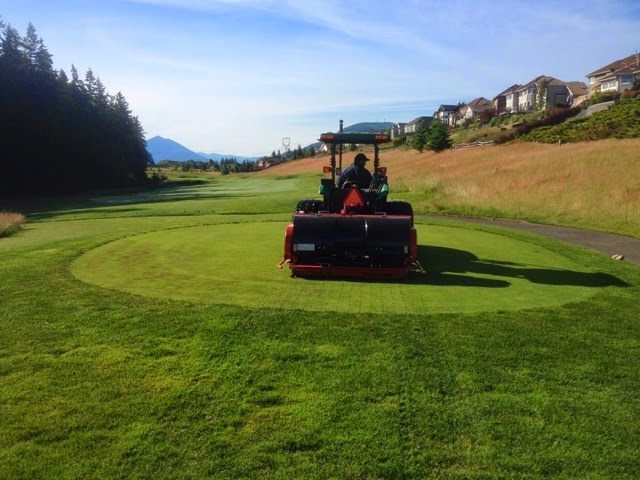
This year, we have chosen to remove thatch on our fairways using our verticutter, then following behind with our newly purchased deep tine aerator to loosen our soils.  This is a method that we have not had the luxury of employing in past years as we did not have a deep tine aerator.  However, now that we have both of these machines, we are able to get the best of both worlds, remove thatch up top where it has the most impact on ball-roll and use our deep tine aerator to do the rest: relieve compaction, create drainage channels and promote gas exchange which all lead to healthier, better performing playing surfaces.  For more information and highlights on our deep-tine aerator, please view my previous post.

Results of Verticutting.

Verticutting and blowing thatch off fairways.  The large orange machine is the verticutter,
 a PTO- driven tractor attachment called the Wiedenmann Super 500.

The areas that receive extremely concentrated amounts of traffic and compaction, namely our tees and approaches get a little bit more love which translates into a combination of the traditional core removal, verticutting and deep tining.  Tees and approaches, no matter what the year will always need a little bit more TLC as they are very small patches of turf that are essentially bottlenecks for traffic from golfers and maintenance equipment.  With that said, these areas need every advantage that we can give them through promoting ideal growing conditions which also leads to ideal playing conditions.  Hence, we go a little bit more heavy-handed with the cultural practices on these areas.  The cores removed from these areas will end up in all of the skybox footings that were dug out for the Boeing Classic on #14 and #18 this past Summer.  Once all footings are filled and compacted, we will overseed and fertilize these areas to promote germination of new turf.

We will wrap up the month with greens aerification which is scheduled to take place on the North-end practice greens beginning Sunday evening the 28th and continuing all the way through Wednesday, October 1st.  We will be testing our equipment and methods on the nursery and South-end practice greens in the next week or so to make sure we are ready to go at game-time.  As with every year, there is a disclaimer that states we may need to move these dates up or back as it relates to the weather.  One of the most important things we do when we aerify the greens is incorporate new sand into the profile through the holes we make with the aerifier.  The only way that the sand is able to make it's way into those holes is if it is dry.  That being said, if there is rain in the forecast, the sand will be too wet to sift down into the holes.  We will be watching the 10 day weather forecast as the 28th-1st gets closer to see what Mother Nature has in store for those days.  If the weather does not look good, we will need to make some adjustments to the dates in order to capture dry weather.  Any adjustments to these dates will be communicated as soon as feasibly possible.  Please keep your fingers crossed for good, sunny weather!!

Once we are able to complete all of these aforementioned fall cultural practices, the agronomy staff will be doing further work preparing the course for the winter which includes our annual mowing down of the fescue to promote plant health and control of unwanted species growing in the fescue areas.  This will be something that you will see continue quite possibly all the way through the end of October and early November as we have almost 75 acres of the stuff and much of it is on very steep terrain, making it slow-going.  We also plan to target a few areas in the fescue with a herbicide to keep the weeds from overtaking certain areas.

All in all, despite the busy summer, we have no plans to slow down this month as we have a lot of work ahead of us.  With as successful of a season as we have had, it is important to remember that this kind of success does not come without a solid foundation of agronomic practices that set the stage for future success and as I have outlined, that is what we are now turning more of our attention to right now.  Cheers, I hope all of you have enjoyed this summer as much as I have.  See you around the course!


Thursday, June 26, 2014

Let me tell you a secret . . .

The crew has been busy this week punching not just the time clock but all the closely mowed turf too.  You may or may not have noticed this because the impact of what we have been doing on play has been so minimal.

On the fairways and tees we have been using our newly acquired Wiedenmann deep tine aerator at a depth of 6 inches and a 15 degree kicking action that fractures the soil each time a hole is made.  As far as the greens go, we use our porcupine spiker attachment that is mounted underneath our Tru-turf greens rollers at a depth of 1.5 inches.  All of this busy work is part of the program that we have put in place to maintain turf health at an optimal level as we get ready to battle the summer heat and peak golfer and equipment traffic in July and August.  The goals of this program include:

  1. Water penetration.  This helps wet spots dry out and dry spots become more receptive to water that is applied, creating a more consistent playing surface.
  2. Compaction relief.  The golf course has been subjected to increased cart traffic, equipment traffic and foot traffic as we have moved from Spring to Summer weather.  By making holes in the surface and fracturing the soil, we are creating pore space to encourage deeper and stronger rooting which will help the turf tolerate heat and traffic stress this summer.  
  3. Gas exchange.  Oxygen will be allowed into the soil while built-up carbon dioxide is able to escape, creating a healthy growing environment for the turf which leads to a stronger turf plant.  

Punching tees on #8. 

Our Wiedenmann deep tine aerator in action on #1 fairway.
One of the reasons we love our new deep tine aerator so much is that it is so easy to use year-round because the impact on play is so minimal but the benefits are incredible.  Take a look at the two pictures below, the first one shows a fairway that was punched that day and the second one is a fairway that was punched three days ago.  See, what I mean by low-impact?!  Isn't it great?

Fairway that was punched on the same day this picture was taken.

Fairway that was punched three days ago.


We also love our porcupine spiker.  We used to have to put small tines on our greens aerifer, send out an operator to walk the course with a slow moving machine to aerate then send a roller behind him to smooth out the surface.  Not anymore!  Our porcupine spiker attachment allows us to do two things on one- aerate and roll.  The manpower required for this practice is reduced and we can do it much faster and more often which will help us keep the greens healthier year-round.  The impact on ball-roll is nonexistent as evidenced by the photos below.  Dare I say if I hadn't told you that we did this practice you may not have even noticed.

Porcupine Spiker attachment under our Tru-turf roller.

Close-up of a green that was spiked today.  Tomorrow you probably
won't even see these holes.

What holes?  Greens are healthy and rolling true!

Tuesday, June 10, 2014

Spring Project Recap

It's already the second week in June and looking back, the month of May practically flew by despite it being one of the longest months of the year.  During May the staff was very busy with some projects that will have a huge impact on the long-term aesthetics and playability of the golf course and I wanted to take a moment to do a quick recap of these projects.

#1:  Drainage Project on the 18th hole.  

The installation of 4,000 linear feet of 4" perforated drain pipe on this hole is now complete.  We were able to tackle the most saturated areas, mainly at the interface of the fairways and rough and the bottom portion of the fairway.  With the change in the weather, the course has dried out and will stay that way as we head into the summer months.  The immediate benefits will be most noticeable this winter when the rainy season returns.  Our ultimate goal with any drainage project is to improve the playing conditions during the shoulder seasons when the weather bounces back and forth between wet and dry weather cycles.  We are very pleased to say that we have installed over a mile of drainage since January 2014 (6,000 linear feet).  This is the most drainage we have ever been able to install in one year since the construction of the golf course.  

Miles re-installing the sod on top of a newly-filled drain line.

Installing pipe.

Another huge boulder uncovered.  Too many to count were found!

The weather finally dried out a bit in May, providing better working conditions in
contrast to what we experienced in late April.


#2 Brush Clearing on the left of the 15th hole

As I outlined in a previous post, the canyon on the left side of #15 had become extremely overgrown over the years.  To remedy this, we brought in goats to graze on whatever they could reach and finished by having a logger come in and cut down the remaining sapling trees and bushes.  The result unveiled a nice clean cliff edge that improved sight lines from the tee and fairway and added another dimension to the psychological effect of how one may choose to play this hole. 

Finished Product on #15.

#3 Removal of Pasture-Type grasses on Bunker Faces

Last Spring, I outlined a herbicide application process that we were experimenting with on our bunker faces in an attempt to remove some of the weedy pasture type of grasses.  This grass is coarsely textured and a lighter green color in comparison to the finer textured grasses around it, making it stand out like a sore thumb.  The process worked so well last Spring that we decided to do a full-scale treatment on all of our bunker faces and the results are now beginning to take full effect with many of these patches melting out of the stand.  You can read more detail on the process in my blog post from last Spring here.


The off-color white spots are the areas that we applied Tenacity.

The herbicide works by bleaching-out the chlorophyll in the plant which
makes the plant unable to use the sunlight's energy to sustain itself leading
to death.

#4  Deep-Tine Aerification of Fairways

 Maybe some of you have seen this orange machine behind our tractor zooming around our fairways recently.  Let me introduce you to one of the newest additions to our equipment fleet, the Wiedenmann Terra Spike XF.  This machine is essentially an aeration machine that unlike our old one, has the ability to remove compaction up to 8.5 inches and "kick" the soil, creating a pocket of up to 1 inch below the surface.  Using this machine to break up compaction at a deeper depth than ever before (5+ inches more) will lead to better root growth, help the turf make better use of water and nutrients, improve the flow of water and balance of air.  These benefits will lead to overall better turf conditions year round including shoulder-season drainage.  We plan to use this machine often as the benefits are so great and the impact on play is so little.  The holes that are made by the machine have no affect on how the ball rolls on the fairways and the holes close up quickly.  
#15 Fairway being deep-tined

The after-result.  These holes were healed-over in a matter of days.

These are the tines used on the machine, allowing us to penetrate the hard-pan below
our fairways which will be one of the tools we use to improve course drainage over
the next few years.

The tines are mounted two per block for a total of twelve tines.  We have to change-out
the tines an average of every three fairways aerified because the sand cap is so
coarse, wearing down our tines quickly.

Tuesday, April 29, 2014

#18 Drainage Project Update

Many of you have been watching the progress of our drainage installation project from the windows of the grille in the clubhouse and seen some of the progress that we have made over the past couple of weeks.  If you are among the crowd following the progress from the grille windows, my guess is it has had a lot to do with the weather we have experience as of late which means it has been WET and RAINY.

As you can imagine, wet and rainy are not necessarily a friendly combination with the heavy equipment required to complete this project.  We have had to use lots of plywood to protect the turf including a trash pump on several occasions when the freshly dug ditches have filled completely with water.  To add to the fun, our soil type has a large number of boulders a bit larger than the size of a basketball.  These slow down the progress as special care has to be taken to pry them out of the way and remove them.

The good news is that we have been able to install just north of 1,000 linear feet out of the 4,000 feet that we plan to install.  To keep the pace of work moving along as smoothly as possible in addition to mandatory worker safety, we have needed to move the tee blocks forward onto the fairway to keep golf balls from hitting the drainage crew and the equipment.

This practice will only occur Monday-Friday with the blocks being returned to the tees each weekend.  We will do our best to keep the yardages as long as possible, however, there may be days where we need to play this hole as a par 3 in order to keep the balls in front of the active work site.  If you remember, this is the same practice that we utilized two years ago when we did large-scale drainage installation on holes #8 and #11 which as you can see today, worked wonders!  Short term pain = long term gain, right?  Your patience is much appreciated as we work to get this course improvement project completed.  Here are a few fun pictures of the progress we have made along the way.


First and foremost, I would like to thank and recognize the team responsible for the
hard work on this project.  From left to right, Sam Bonda, Miles Brownell and
our contractor, Daniel Soushek of Golf Plus Construction.  Great work!

We started on the left side of the fairway between the bunker complexes to capture
as much water coming off the hill as possible with two trenches following
the contour of the fairway.

This picture shows some of the WET conditions that the team has had to
work with so far.  Notice all the surface water flowing into the open trench.
This photo shows the area between the fairway bunker complexes where much
of the work to-date has been completed.
Daniel has a very organized approach to installation:  dig, install pipe, add gravel,
top with sand followed by resodding all within an hour of opening up a new trench.

This is what 4,000 feet of drainage pipe looks like.  A LOT!

One of the many rocks found.  Nobody gets excited to see these.

And another.
And again.  

Monday, April 14, 2014

#13 Green Views, Goats and Drainage!

If you have a child, relative or friends with kids under the age of 10, you probably know the catchphrase, "To infinity and beyond!" from the Toy Story movie that features the toy space ranger hero, Buzz Lightyear.  I love this because this describes exactly the impact of what I am about to discuss here regarding one of our latest course improvement projects.

In my last post, I talked a little bit about the natural features of this property that Jack Nicklaus did such a good job of highlighting in the routing of the course.  Just like the canyon on the left of #15, the area behind the green on #13 had become quite overgrown in the last 15 years and the fir trees on the hillside were beginning to create a little bit of a wall and dilute the spectacular view off the back of this green.  I found another picture from the early 2000's that shows what this hole used to look like.

#13 in the early 2000's.

Now, flash forward 12 to 15 years and this next picture shows how much the trees had grown over the years, blocking off that once clean edge of the canyon.

#13 in 2014.
This morning, we sent three professional loggers from Cedar Falls Tree Service with chainsaws about 60 feet down the edge of the hillside for a few hours and BOOM!  Look at the difference!  The trees no longer block the view like before.  We now have what I have personally dubbed the "infinity and beyond" green in which your eye follows the approach, rolls onto the green and jumps off into the sky, Mount Si, the valley and everything else- "to infinity and beyond!"

#13 Green in 2014 AFTER tree removal.
                         
Here's an up close shot of what the edge of the cliff looks like now.  Dramatic!
                        
You can even see all the way to the 15th hole with the trees gone!

Pretty cool huh?  We still have a little bit more work to do on the right side between the switchback in the cart path and #14 tees.  On Friday that little grove of trees right there will be cut out and we will then have a nice seamless line running from behind the green all the way down and around the 14th hole.  

While we are on the subject of view lines, we also did a little bit of light trimming on the "V" that  gives you the peek-a-boo views of Snoqualmie Falls from the 12th tee so that view line will also be much better than it was previously.  And of course, the action down on the 15th hole is going great.  We started out with 37 goats in the pen over the weekend and as of today, we added another 27 goats to get our total up to 64 and make quicker work of things.  The plan is to let the goats eat whatever they can and everything that is left over will be cut by hand such as the blackberry canes and the small to medium sized trees.

setting up the chute to move goats from the trailer into the pen.
                        
Notice the difference between what is inside and outside of the fence.  What is inside used
to look like the outside.  These goats don't leave anything behind!
"Selfie" of Assistant Superintendent Tate Berg and one of the baby goats.
Everyone works at their own pace.  You may see some napping but rest assured,
  come 3 AM, they will be logging their hours and doing their part.
                         
Ready for more?  This truck from Golf Plus Construction showed up in the agronomy maintenance yard this morning and unloaded a couple of nice pieces of equipment specifically for drainage work.  This past winter, the agronomy crew was able to install 2,000 feet of drainage in-house using our own equipment.  While this is a LOT of drainage- we have decided to do more, this time with a contractor with specialized equipment that can make quicker work of things.  About 4,000 feet more!  Our agronomy team along with the ownership are committed to improving shoulder season playing conditions and this is part of the effort to keep this initiative moving along.


Much of this work will be concentrated on the 18th hole and will take about two weeks to complete.  Our contractor Daniel Soushek with Golf Plus construction has an extensive resume that includes work performed on many area golf courses and he worked with us in 2004 when the left side of the 12th green washed down the hill.  

Our plan is to begin tomorrow morning with a "soft start" and as we move along, things will move along quicker and we will work to minimize the impact on play.  There will be days where we may need to move the tee markers onto the fairway out of the line of work in the name of safety and our contractor's pace of work.  We will be working with the golf shop to direct daily communication and placement of the tees.  

This is an exciting time for the club with the many new improvements happening on the course along with the extensive remodel of the clubhouse that began today.  I will do my best to keep the blog fresh with the latest happenings of what we are doing.  I want to thank everyone in advance for their patience as we work to get these projects completed and hope that you feel the same enthusiasm for these projects as we do.  Feel free to wave me down on the golf course or shoot me an email if you have any questions, I'm always happy to chat and thanks for taking the time to read through this long post!